
If you live on a London "Red Route": those high-traffic arteries where the double-decker buses never seem to stop: you’ve likely already tried the standard solutions. You might even have modern double glazing installed, only to find that while the high-pitched whistling of the wind is gone, the deep, floor-shaking rumble of the morning commute still vibrates right through your pillows.
The direct reason for this is surprisingly simple: standard double glazing is designed primarily for heat, not heavy traffic noise. To truly silence the low-frequency drone of a London bus, you need a substantial air gap: ideally 100mm or more: between your panes of glass.
In this guide, we’ll look at the science of why that "dead air" space is your best friend when it comes to reclaimed peace and quiet.
The Problem with the "Short Gap"
Most modern double-glazed units feature an air gap of about 16mm to 20mm. For thermal insulation, this is fantastic; it’s the perfect width to stop heat from jumping from one pane to the other via convection.
However, when it comes to acoustics, a 20mm gap is actually quite problematic. At low frequencies: the kind produced by heavy engines and tires on tarmac: the two panes of glass in a standard window begin to act as a single unit. Because they are so close together, the air between them acts like a stiff spring, transferring the vibration of the outer pane directly to the inner pane.
This is why you can still hear the low "thrum" of a lorry even with expensive new double glazing. To break that connection, you have to "decouple" the windows.
Why 100mm is the Magic Number
When we install secondary double glazing, we aren't just adding more glass; we are creating a massive acoustic buffer. By fitting a discrete internal unit approximately 100mm to 150mm away from your existing window, we change the physics of the entire opening.
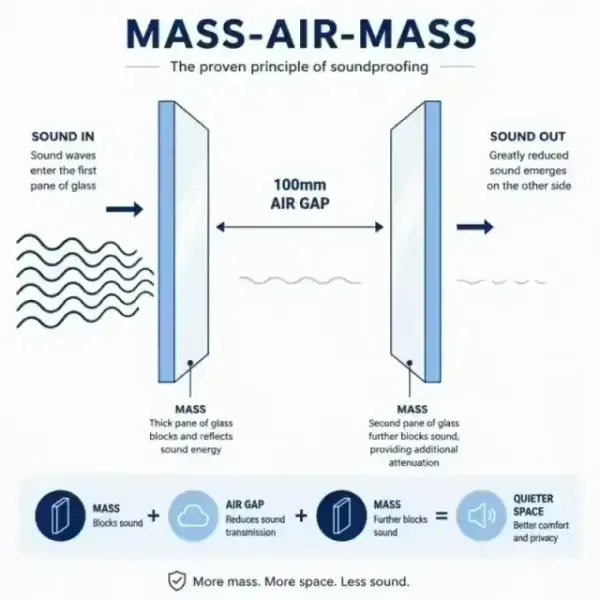
At a 100mm distance, the "spring" of air becomes much softer. The sound waves lose a significant amount of energy as they travel across this larger void. This setup follows the "Mass-Air-Mass" principle. You have the mass of the original window, a large "acoustic cushion" of air, and then the mass of the secondary unit.
The result? While standard double glazing might reduce noise by around 30 decibels (dB), a well-fitted secondary glazing system with a 100mm gap can achieve a reduction of 45dB to 50dB or more.
Understanding the Decibel Difference
In the world of acoustics, decibels are logarithmic. This means a 10dB reduction isn’t just "a little bit" quieter: it is perceived by the human ear as a halving of the volume.
If your London street sits at a noisy 75dB (typical for a Red Route at peak times):
- With standard windows, your indoor level might be 55dB: similar to the background noise of a busy office. You’ll still hear every bus.
- With 100mm gap secondary glazing, your indoor level can drop to 35dB: the level of a quiet library or a peaceful suburban bedroom at night.
For a deeper dive into these numbers, you might find our guide on 80% noise reduction helpful for visualizing the transformation.
Combating the "Low-Frequency Rumble"
London noise isn't just one "sound." It’s a cocktail of different frequencies.
- High Frequencies: Sirens, bird chirps, or wind. These are relatively easy to block with almost any solid barrier.
- Low Frequencies: Bus engines, freight lorries, and the underground. These are long, powerful sound waves that physically shake structures.
Standard double glazing is notoriously poor at blocking these low frequencies because the narrow gap resonates at a frequency that matches traffic noise. By expanding that gap to 100mm, we push that "resonant frequency" way down, often below the range of human hearing.

The Role of Acoustic Glass
While the air gap does the heavy lifting for traffic rumble, the glass itself acts as the final gatekeeper. We often recommend using acoustic laminated glass for our secondary units.
Unlike standard glass, acoustic laminate is made of two layers of glass "sandwiched" around a special PVB (polyvinyl butyral) interlayer. This interlayer is designed to absorb vibration rather than pass it through. It’s like the difference between hitting a bell (standard glass) and hitting a piece of wood (acoustic glass). One rings; the other thuds.
You can read more about how we select these materials in our Ultimate Guide to Acoustic Glass.
Practicality in London Homes
"100mm sounds like a lot of space," is something we hear often from homeowners in Westminster or Kensington where every square inch matters. However, most London window reveals (the "shelf" the window sits in) are deep enough to accommodate this without encroaching into the room.
Because the frames are slimline and designed to align with your existing sash or casement lines, the installation is often visually discreet once you step back. This is particularly important for period homes or listed buildings where you may need to retain the external windows.

A Transformation You Can Feel
We’ve seen clients go from needing earplugs to sleep in their own bedrooms to being able to enjoy a quiet Sunday morning without the constant intrusion of the TFL network.
Living on a Red Route doesn't have to mean living with the noise. It’s not about the number of panes you have, but the distance between them and the quality of the seals. By doubling up and respecting the physics of the 100mm air gap, you can turn a "loud" London flat into a genuine sanctuary.
If you’re tired of the rumble, the first step is usually a simple survey to see how much of a gap your current window reveals will allow. In almost every case, we can find a way to get you that magic 100mm of silence.
Want to see how we’ve helped other Londoners reclaim their peace? Take a look at our case studies on street noise reduction or get in touch for a chat about your specific windows.