
If you live along one of London’s notorious "Red Routes", the A1, the A12, or the North Circular, you’re intimately familiar with the low-frequency thrum of the 24-hour bus service and the rattle of heavy goods vehicles. It’s a relentless wall of sound that standard double glazing often fails to stop.
So, can you actually achieve a quiet home when a red bus is idling right outside your window? The short answer is yes. By installing acoustic secondary glazing with a significant air gap, you can reduce incoming noise by 45 to 55 decibels. This isn't just a minor improvement; it’s the difference between a room that feels like it’s in the middle of a motorway and one that feels like a peaceful library.
Understanding the Decibel: Why 10dB is a Huge Deal
When we talk about noise reduction, we use the decibel (dB) scale. It’s a bit of a tricky thing because it isn't linear like a ruler; it's logarithmic. In plain English, this means that every time you decrease the noise level by 10dB, you are actually halving the perceived volume in your ears.
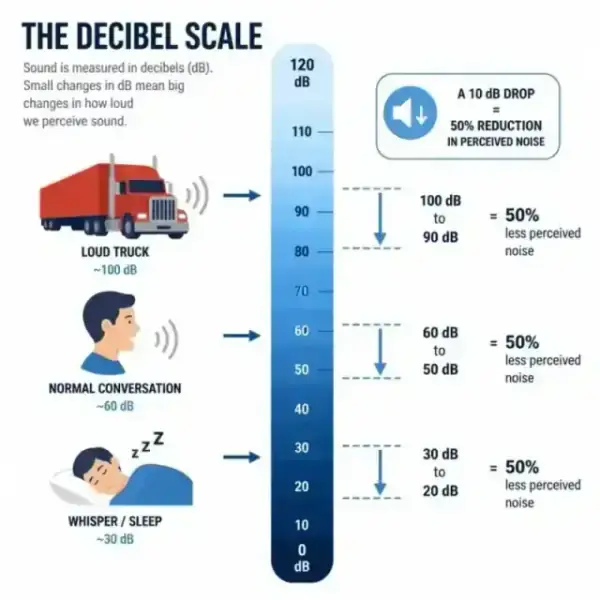
A typical London Red Route generates noise levels around 80dB to 85dB. Standard double glazing usually provides about 31dB of insulation. If you do the math, that leaves about 50dB of noise entering your living room: comparable to a loud conversation happening right next to you, all day and all night.
Our high-performance secondary glazing windows are designed to target a 45–55dB reduction. When you add that to your existing windows, the noise level drops to around 30dB. That is the sound of a whisper. It’s the difference between being kept awake by a truck and sleeping through the night.
The Three Pillars of Silence: Mass, Damping, and Decoupling
To block the complex "cocktail" of noise found on London’s busy roads, you need a solution that attacks the physics of sound from three different angles.
1. Mass: The Weight of the Matter
Sound is essentially a pressure wave that tries to vibrate everything in its path. If your window is light and thin, it’s going to vibrate like a drum skin, passing that noise straight into your home. By using thicker glass: specifically 6.4mm or 10.8mm panes: we add "mass." A heavier pane is much harder for a sound wave to move, meaning less noise makes it through.
2. Damping: The "Sandwich" Effect
This is where acoustic glass becomes your best friend. Unlike standard float glass, acoustic glass is a "laminated" sandwich. It consists of two layers of glass bonded together by a special acoustic PVB (Polyvinyl Butyral) interlayer.
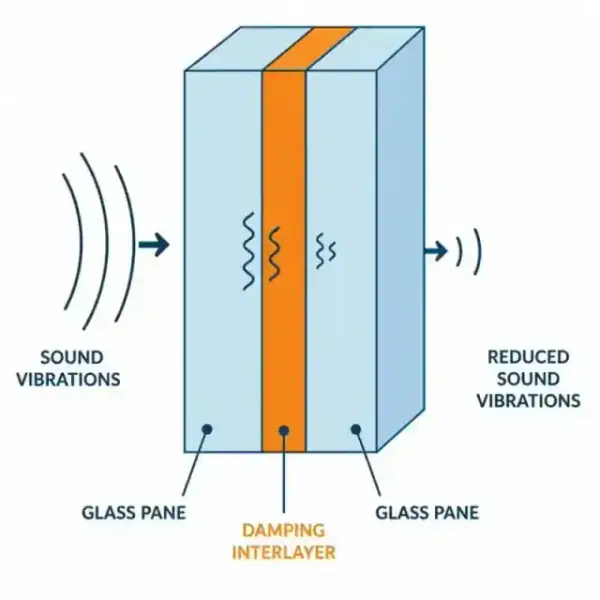
This interlayer acts like a shock absorber. When sound waves hit the glass, the PVB layer absorbs the vibrational energy, turning it into a tiny amount of heat rather than letting it pass through as noise. It’s specifically tuned to tackle the frequencies that humans find most irritating.
3. Decoupling: The Secret of the "Big Gap"
The most important factor for Londoners near heavy traffic is decoupling. In standard double glazing, the two panes of glass are only 16mm to 20mm apart, held together by a rigid frame. This means the vibration from the outer pane easily "jumps" across to the inner pane.
Secondary glazing is different. We install a completely independent window frame on the inside of your existing one. This allows us to create a massive air gap: ideally between 100mm and 200mm.
Why Red Routes Need the "Big Gap"
Low-frequency noise: the deep rumble of a diesel engine or the "thump-thump" of a bus: has long, powerful wavelengths. Small gaps, like those found in standard double glazing, are almost invisible to these waves; they simply pass right through.
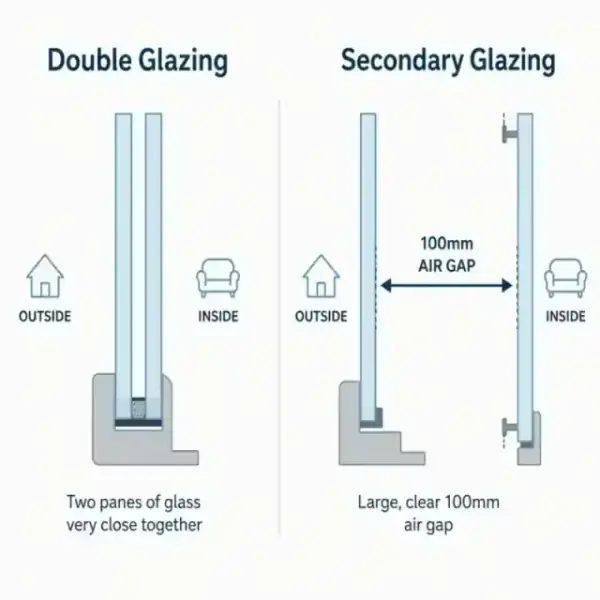
By creating a 100mm+ gap, we create a "cushion" of air that is large enough to break up these long wavelengths. This "mass-air-mass" system is the gold standard for soundproofing. It ensures that the primary window and the secondary window are working independently, rather than vibrating in harmony.
Protecting Your Heritage While Gaining Your Sanity
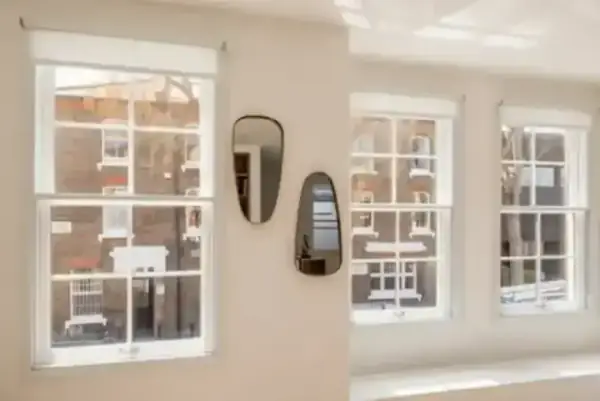
Many of our clients live in beautiful period homes or conservation areas where replacing the original sash windows isn't an option. You might be facing a "Red Route" outside your Victorian terrace, but you don't want to lose the charm of your original timber frames.
The beauty of our secondary double glazing is that it is virtually invisible from the outside. Because it sits on the inner reveal of your window, it doesn't require planning permission: even for listed buildings. You keep the historic look of your home, but you gain the peace and quiet of a modern acoustic suite.
Real-World Impact: What Our Customers Say
We recently worked on a property near the A1 in Islington. The homeowner had struggled with sleep for years because of the constant vibration from the bus stop directly outside. We installed horizontally sliding secondary glazing with 10.8mm acoustic glass and a 150mm air gap.
The result was transformative. In her own words, "It was like someone finally found the mute button for the street." She could finally use her front bedroom as a nursery, safe in the knowledge that the traffic wouldn't disturb the baby.
Professional Installation: The Final 10%
You can have the best acoustic glass in the world, but if there’s a tiny 1% gap in the seal, you can lose up to 10dB of performance. Sound is like water; it will find the smallest leak.
Our installation process focuses on creating an airtight seal. We use high-performance acoustic seals and custom-made frames that fit the unique (and often slightly wonky) apertures of London’s older homes. Most installations take just 1–2 days and involve zero mess or redecorating.
Is it Time to Reclaim Your Peace?
If you’re tired of the "Red Route roar" and want to understand how our bespoke solutions can fit your specific windows, we’re here to help. Whether you have sash, casement, or arched windows, there is a science-backed solution to give you the quiet home you deserve.
Ready to turn down the volume? Explore our secondary glazing costs or contact us today for a professional survey. Let’s make your home the quiet sanctuary it was always meant to be.
- * *
WhatsApp us