
If you’ve ever sat in your London living room and felt like the passing traffic was practically sitting on your sofa, you’ve probably looked at your windows and wondered why they aren't doing their job. Maybe you even have modern double glazing, yet the low-frequency thrum of a Red Route bus still vibrates right through the glass.
The secret to fixing this isn't just "thicker glass." It’s actually a bit of a counter-intuitive trick used by acoustic engineers called glass mismatching (or asymmetric glazing).
The short answer? If your two panes of glass are the same thickness, they vibrate at the same frequency. They "talk" to each other, passing noise through your home like a relay race. By using different thicknesses, you break that rhythm, forcing the sound to work much harder to get inside.
The Science of "Sympathetic Vibration"
Think of two identical tuning forks. If you strike one, the other will start to hum even if you don't touch it. This is sympathetic vibration. Standard double-glazed units often suffer from this exact problem because they typically use two identical 4mm panes of glass.
When a sound wave: let’s say a siren on the A10: hits the outer pane, that pane vibrates. Because the inner pane is the exact same thickness and weight, it’s perfectly tuned to pick up those same vibrations and pass them into your room.
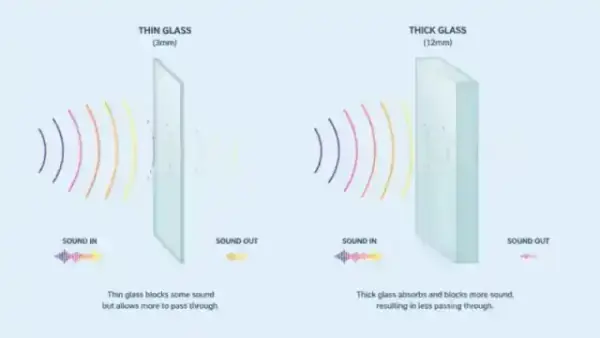
By using "mismatched" glass: for example, a 6mm outer pane and an 8.8mm acoustic glass inner pane: you create a mismatch in their critical resonance frequencies. The second pane simply isn't "tuned" to the first one's vibrations. It’s a simple change that makes a massive difference in how much noise actually enters your home.
Decibels: Why a "Small" Number is a Big Deal
When we talk about soundproof secondary glazing, we often mention decibels (dB). It sounds technical, but it’s the most important metric for your comfort.
Sound isn't measured on a straight line; it's measured on a logarithmic scale. This means that a 10dB reduction isn't just a "bit" quieter: it is perceived by the human ear as a 50% reduction in volume.
If your current windows provide 25dB of noise reduction and we can push that up to 45dB with high-performance secondary glazing, your home won't just be "a bit better." It will feel like you’ve moved to a different, much quieter neighborhood. For those living on London's "Red Routes" (the major arteries like the A1, A4, or A12), moving from "loud" to "library-quiet" is often a life-changing upgrade for sleep and mental health.
The London Red Route Challenge
Living in London is fantastic, but the "Red Routes" bring a specific type of acoustic nightmare. These roads carry 30% of London's traffic, including heavy buses and freight trucks that create a deep, low-frequency rumble.
Standard double glazing is surprisingly bad at blocking these low frequencies. This is where noise reduction windows for London really prove their worth. Because we install an entirely separate internal window, we can create a much larger air gap than you'd find in a standard double-glazed unit.
While a double-glazed window might have a 16mm or 20mm gap, secondary glazing allows for a gap of 100mm to 200mm. That "buffer zone" of air acts as a massive shock absorber for sound. Combined with the glass mismatching we discussed, you’re creating a formidable barrier against the relentless noise of the city.
Why "Acoustic Glass" is Different
You might hear people talk about "laminated glass" and "acoustic glass" as if they are the same thing. They are close cousins, but acoustic glass has a special "secret sauce."
Standard laminated glass is two sheets of glass stuck together with a plastic interlayer (PVB). It’s great for safety because if it breaks, the glass stays stuck to the plastic. Acoustic glass takes this a step further by using a specifically engineered, "softer" acoustic interlayer.
This interlayer acts like a dampening sponge. When sound energy hits it, the plastic layer absorbs the vibration rather than passing it through. If you use a piece of 6.4mm or 8.8mm acoustic glass as your internal secondary glazing, you are adding both mass and damping: the two greatest enemies of noise.
The Power of the Air Gap
If glass mismatching is the secret ingredient, the air gap is the main course. The physics are simple: the further the sound has to travel through air between two layers of glass, the more energy it loses.
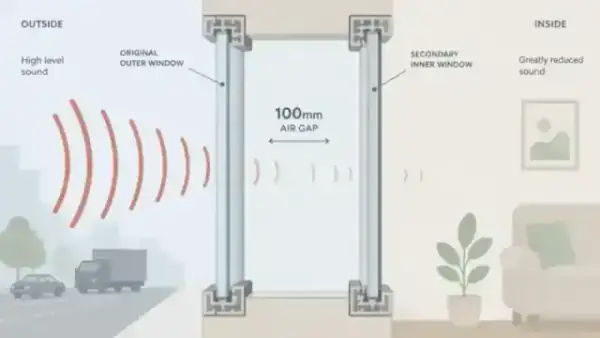
In a standard double-glazed unit, the panes are very close together. This actually creates a "spring" effect where the air between the panes compresses and expands, helping to push the vibration from one side to the other. By increasing that gap to 100mm or more with secondary glazing, you "decouple" the two windows. The air is no longer acting like a tight spring; it’s acting like a vast, empty space that sound struggles to cross.
Better for Your Home, Better for Your Budget
One of the best things about this approach is that it’s often 40-60% cheaper than full window replacement. If you live in a period home or a listed building, you likely aren't even allowed to change your original sash windows.
Secondary glazing is the "invisible" hero here. We can install vertically sliding units that align perfectly with your existing sash windows or hinged units for casement styles. From the outside, no one will ever know it’s there. From the inside, you’ll finally be able to hear yourself think.
What Should You Do Next?
If you're tired of the city noise intruding on your peace, the solution isn't just adding "more glass": it's adding the right glass in the right way.
- Check your current seals: Sometimes a simple draft is letting in more noise than the glass itself.
- Measure your depth: See how much space you have on your internal windowsill. A gap of 100mm is the "sweet spot" for noise reduction.
- Choose the right glass: Ask about asymmetric configurations and acoustic laminated options to ensure you're breaking those resonance frequencies.
You don't have to live with the roar of the A1 or the constant hum of the neighborhood. A bit of clever "mismatching" might be exactly what your home needs to become the sanctuary you deserve.
If you're curious about how this would look in your specific London home, you can explore our secondary glazing cost guide or reach out to us for a survey. We’ve spent years perfecting the art of the "mismatch" to keep London homes quiet.
- * *
WhatsApp us