
If you’ve ever spent an afternoon on the Cromwell Road or lived within earshot of the A40 Westway, you know the specific "London roar." It’s a relentless, low-frequency hum of HGVs, buses, and constant traffic that seems to vibrate through the very walls of Kensington’s most beautiful homes.
For one of our clients living in a stunning Grade II listed Georgian terrace on Cromwell Road, this roar wasn't just background noise; it was an intruder. They had the high ceilings, the original sash windows, and the prestigious address: but they also had a consistent 78dB of traffic noise leaking into their living room. To put that in perspective, 78dB is roughly equivalent to having a vacuum cleaner running right next to your sofa, all day, every day.
The challenge was clear: how do we achieve soundproofing flats in Kensington without touching the original fabric of a protected heritage building?
The Cromwell Road Dilemma: 78dB vs. Grade II Status
Living in Kensington and Chelsea or Westminster brings a unique set of hurdles. These boroughs are home to some of the world's most significant period architecture, and local conservation officers are: rightly: very protective of them.
When our client approached us, they were at their wits' end. They couldn't replace the windows because of the Grade II listing. Standard "thick" curtains did nothing for the low-frequency rumble of the A4 traffic. They needed a solution that was invisible from the street but transformative from the inside.
The Problem: Why Single Glazing Fails
Original sash windows are beautiful, but they are essentially acoustic "holes" in your wall. Even when perfectly maintained, a single pane of glass offers very little resistance to sound waves. In Kensington, where many homes sit directly on "Red Routes," the noise levels frequently exceed 75dB.
At 78dB, the external noise at this Cromwell Road property was making sleep difficult and peaceful conversation nearly impossible.
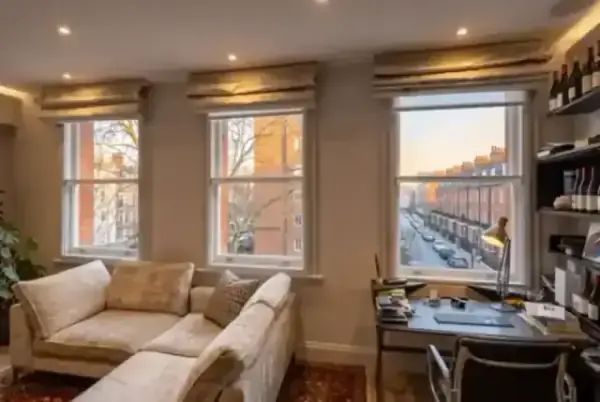
The Solution: The Science of the "Silent Gap"
To turn this Kensington flat into a sanctuary, we didn't just need glass; we needed the right combination of glass and air. For secondary glazing London projects, we often recommend a specific high-performance setup for properties facing major arterial roads.
For this project, we specified:
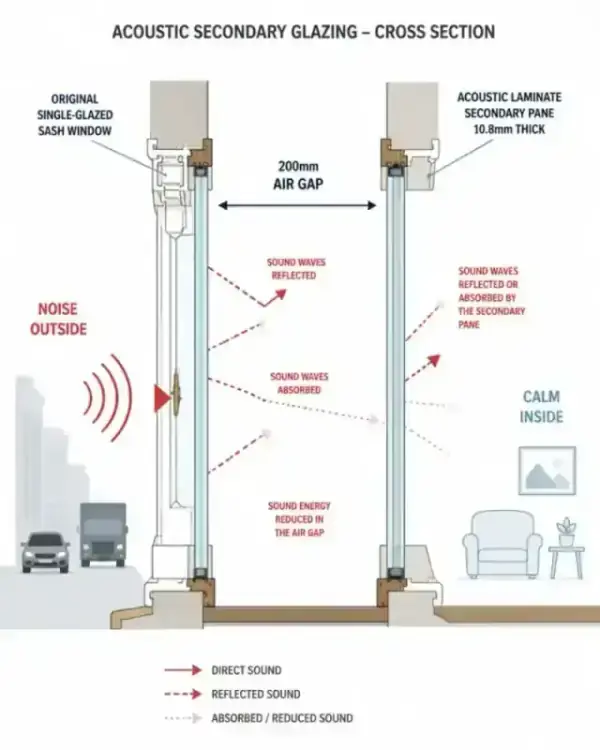
- 10.8mm Acoustic Laminate Glass: This isn't your standard window pane. It consists of two layers of glass bonded together with a special acoustic interlayer that specifically targets and dampens sound vibrations.
- A 180mm Air Gap: This is the secret sauce. While many off-the-shelf "soundproof" windows fail because the panes are too close together, the 100mm+ gap matters because it creates a decoupling effect. The air acts as a shock absorber.
How it works technically
The original window handles the weather, while the secondary glazing handles the noise. By placing the 10.8mm acoustic pane 180mm away from the original sash, we created a massive acoustic barrier.
The Result: From a Vacuum Cleaner to a Library
The results on Cromwell Road were, quite literally, life-changing.
After the installation, we measured the noise reduction. The external roar of 78dB was slashed by 52dB. Inside the flat, the noise level dropped to roughly 26dB. In acoustic terms, that is the difference between a loud office and a quiet library.
The client could finally enjoy their home. The HGVs and buses on the A4 became a silent movie playing outside their window, rather than a soundtrack to their lives. Because our units are slimline and powder-coated to match the existing woodwork, the installation was virtually invisible, satisfying both the client's aesthetic tastes and the conservation requirements.
Beyond Kensington: The Notting Hill Gate Case
Kensington isn't the only borough facing these "traffic corridors." We recently completed a similar transformation at Notting Hill Gate (W11), right near the elevated section of the A40 Westway.
The noise profile there is slightly different: more of a high-speed drone than the stop-start rumble of the A4. Our measurements showed peaks of 80dB due to the motorway's elevation.
The Notting Hill Specification:
- Glass: 10.8mm Acoustic Laminate.
- Air Gap: 200mm (The extra 20mm helps further with high-speed road resonance).
- Reduction: 52dB.
Just like the Cromwell Road project, the Notting Hill property went from being "uninhabitable" in the owner's words to a peaceful retreat. This is why secondary glazing for period homes London is becoming the gold standard for those who want modern comfort without losing historical charm.
Why Westminster and Kensington Homeowners are Choosing Secondary Glazing
If you live in Westminster, Chelsea, or Kensington, you’re likely dealing with one of three things:
- Conservation Area Restrictions: You cannot change the look of your building's exterior.
- Listed Status: You are legally forbidden from replacing original windows.
- The "Red Route" Reality: You live on a major road that will never be quiet.
Secondary glazing is the only solution that addresses all three. It is a "reversible" installation, meaning it doesn't permanently alter the fabric of the building: a huge plus for listed building insulation and planning.
Furthermore, it is significantly more effective at noise reduction than even the most expensive new double-glazed sash windows. New double glazing usually offers around 30-35dB of reduction. Our specialized secondary setups regularly hit the 50dB+ mark.
More Than Just Quiet: The Thermal Bonus
While the Cromwell Road and Notting Hill clients came to us for silence, they both noticed an immediate secondary benefit: warmth.
Old sash windows are notorious for drafts. By sealing the internal "reveal" with a secondary unit, you're essentially adding a high-performance thermal seal to your home. Many of our clients find they can turn their thermostat down by 2 or 3 degrees immediately after installation. In a large Kensington terrace, that adds up to significant savings on energy bills. You can read more about secondary vs. double glazing for energy bills here.
Reclaim Your Peace of Mind
Living in the heart of London shouldn't mean sacrificing your right to a quiet night's sleep. Whether you're dealing with the A4 in South Kensington, the A40 in Notting Hill, or the busy thoroughfares of Westminster, there is a way to silence the city.
The transformation from 78dB to a silent sanctuary isn't magic: it’s just good physics and the right glass.
If you're tired of the traffic roar and want to see how we can tailor a solution for your specific property, we're here to help. We know these boroughs, we know the planning restrictions, and most importantly, we know how to make London quiet again.
Ready to silence the roar? Explore our Kensington and Chelsea guide or get in touch for a bespoke survey.