
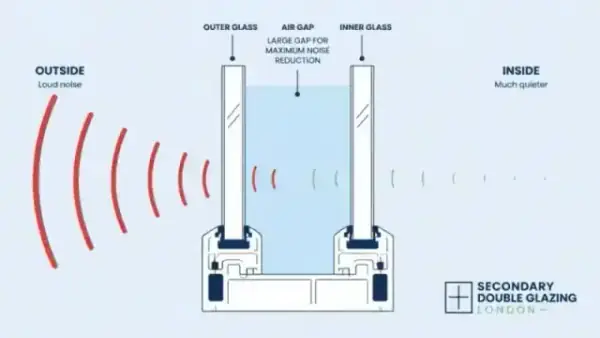
If you live in London, you don’t just hear noise: you live in it. It’s the low-frequency hum of a diesel bus idling at a red light, the sharp "nee-naw" of an ambulance cutting through your morning coffee, and the constant, rhythmic hiss of tyres on wet tarmac. Most of us just learn to shout over it or turn the TV up a few notches.
But what if you could actually turn the volume down on the city?
When people talk about noise reduction windows, they often throw around terms like "decibels" and "acoustic glass" as if everyone has a PhD in physics. The truth is, the science of quiet is actually quite simple once you understand two things: how sound travels and why a simple gap of air is your best friend.
The Decibel Cheat Sheet: Why 10 is the Magic Number
First, let's talk about decibels (dB). Most people assume that if you reduce noise by 10dB, you’ve cut it by 10%. In reality, sound doesn’t work like a volume knob on a linear scale; it works on a logarithmic one.
Here is the only stat you really need to remember: A reduction of 10 decibels is perceived by the human ear as roughly halving the noise.
If your current single-glazed windows are letting in 80dB of street noise (about the level of a loud alarm clock), and we install a system that cuts that by 40dB, you aren't just getting a 50% improvement. You are effectively halving the noise, then halving it again, and again. It’s the difference between a roar and a whisper.

When we talk about achieving 80% noise reduction, we are aiming for that sweet spot where the city hum becomes a background blur that you can finally ignore.
The Secret Sauce: The Power of the Air Gap
You might be wondering: "Why can't I just buy standard double glazing and call it a day?"
It’s a fair question. Standard double glazing is great for keeping your house warm, but it’s often surprisingly mediocre at stopping noise. The reason? The gap between the two panes of glass is usually only about 16mm to 20mm.
For heat, that’s perfect. For sound, it’s a bit of a disaster. Because the panes are so close together, they "talk" to each other. When a sound wave hits the outside pane, the vibration easily jumps across that tiny gap to the inside pane. They vibrate in sympathy, effectively acting like a single, slightly thicker piece of glass.
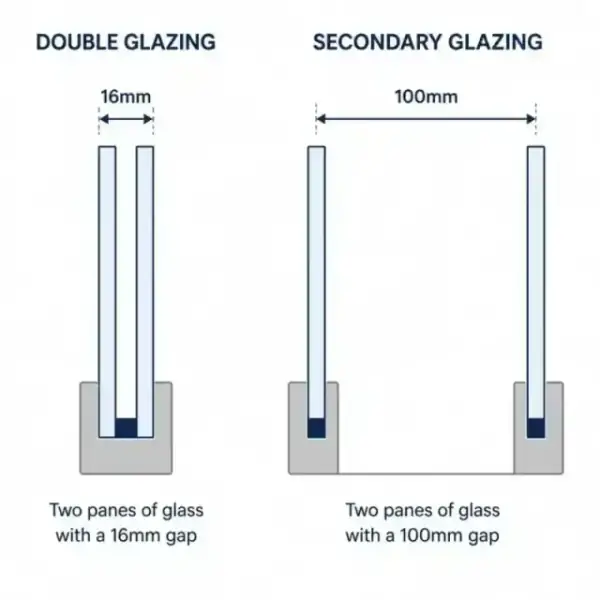
This is where secondary glazing changes the game. By installing a second, independent internal window, we create a much larger air gap: ideally between 100mm and 200mm.
Think of this gap like a buffer zone. When the sound of a London red route bus hits your original window, it vibrates. But because the secondary pane is so far away, that vibration has to travel through a massive cushion of air. By the time it reaches the second pane, it has lost most of its energy. The two windows are "de-coupled," meaning they don't vibrate together. That gap is where the silence happens.
Acoustic Glass: The Shock Absorber for Your Windows
If the air gap is the buffer zone, then acoustic glass is the shock absorber.
Standard glass is rigid. When sound hits it, it rings like a bell (metaphorically speaking). Acoustic glass is different. It’s actually a "sandwich" made of two layers of glass with a thin, transparent layer of Polyvinyl Butyral (PVB) in the middle.
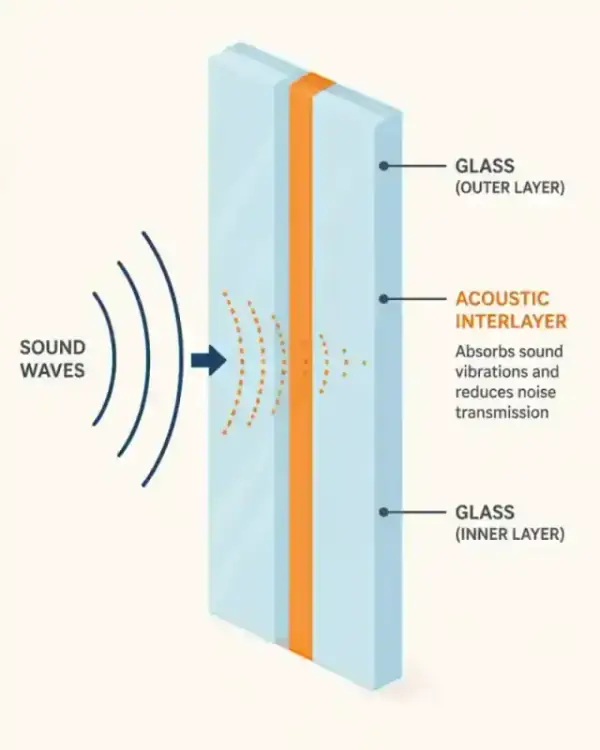
This PVB interlayer is dampening material. It acts like a layer of glue that never fully hardens, absorbing the vibration energy before it can pass through. When you combine acoustic glass with a 100mm air gap, you are building a formidable fortress against London's noise pollution.
Why This Matters for London Red Routes
If you live on a Red Route: those busy arteries like the A1, A4, or A23: you aren't just dealing with "noise." You are dealing with resonance.
Large vehicles like buses and HGVs produce low-frequency sounds. These are the deep rumbles that you can feel in your chest. Low-frequency sound has a long wavelength, which means it is incredibly good at passing through solid objects like walls and thin windows.
Standard windows struggle with this rumble because they are too light. To stop a long, heavy sound wave, you need mass and space. This is why our soundproof windows for London homes specifically focus on thicker glass and those wide air gaps. By using a different thickness for the secondary glass than your original window (for example, a 6mm secondary pane against a 4mm original), you prevent "sympathetic resonance." Each pane is tuned to a different frequency, so the noise gets trapped in the middle.

The "Invisible" Upgrade
One of the best things about this "Science of Quiet" is that it doesn’t require you to ruin the look of your home. If you live in a Georgian terrace or a Victorian conversion, the last thing you want to do is rip out your beautiful original sash windows for chunky uPVC replacements.
Because secondary glazing is fitted to the inside of your existing window, it’s practically invisible from the street. You keep your heritage look, you satisfy the conservation officers, and you get the acoustic performance of a recording studio. Plus, it’s usually 40-60% cheaper than full window replacement.
Quick Summary for the Time-Pressed
- Decibels: Aim for a 10dB reduction to "halve" the noise.
- The Air Gap: Bigger is better. 100mm+ is the goal for traffic.
- Acoustic Glass: The PVB interlayer is the secret to absorbing vibration.
- De-coupling: Keeping the two windows separate stops them from vibrating together.
Ready to Reclaim Your Peace?
Understanding the science is great, but feeling the difference is better. There is a specific kind of "relief" that happens the first time you slide a secondary glazing panel shut and the roar of London suddenly vanishes. It changes how you use your home: you can finally hear the person across the dinner table, and you might actually get a full night’s sleep without the 5 AM bus wake-up call.
If you’re tired of the noise and want to see how these decibels and air gaps would work in your specific home, we’re here to help. We’ve spent years perfecting the art of the quiet London home, and we’d love to show you what’s possible.
- * *
WhatsApp us