
If you’re currently sitting in your London flat, staring at your windows while the rumble of a passing red bus vibrates through your floorboards, you’ve probably searched for "soundproof windows" more than once. The direct truth? Most people approach soundproofing entirely wrong. They treat it like a thermal problem, assuming that what keeps the heat in will also keep the noise out.
It doesn't. Sound behaves like a liquid: it finds the smallest cracks, vibrates through solid materials, and loves nothing more than a thin, uniform barrier.
Whether you’re living on a Kensington High Street "Red Route" or a busy corner in Hackney, here are the seven most common mistakes homeowners make when trying to silence the city: and exactly how to fix them.
1. Assuming Standard Double Glazing is "Soundproof"
This is the single biggest misconception we encounter. Standard double glazing is designed primarily for thermal insulation: keeping your heating bills down. While it’s great at stopping a draft, it’s surprisingly mediocre at stopping the low-frequency roar of London traffic.
Standard units usually consist of two identical panes of 4mm glass with a small 16-20mm gap. This setup can actually create a "drum skin" effect where the air between the panes vibrates in sympathy with the noise outside, amplifying certain frequencies.
The Fix: If noise is your main enemy, you need a decoupled system. Secondary double glazing adds a completely independent internal window. This creates a much larger air gap that physically breaks the path of the sound wave.
2. Ignoring the "Golden Gap" (The 100mm Rule)
When it comes to sound, size really does matter. In the world of thermal double glazing, a 20mm gap is the sweet spot. But for acoustic insulation, 20mm is barely a speed bump for a sound wave.
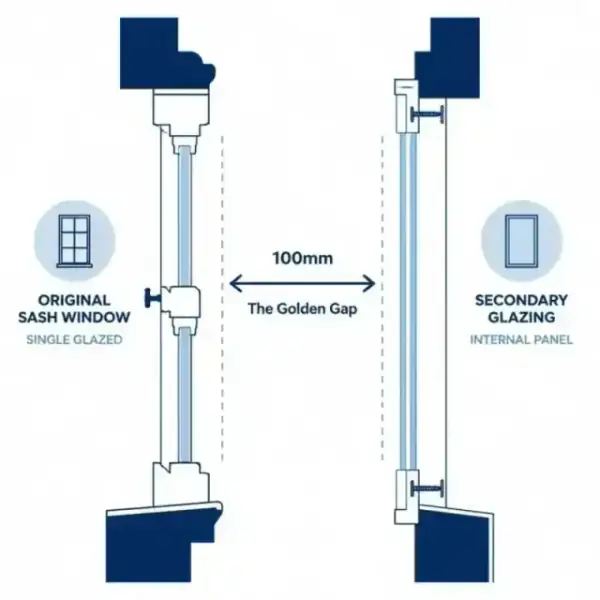
To truly kill the noise from a heavy traffic route, you need distance. Sound waves lose energy as they travel through air, and they lose even more when they have to move from one medium (glass) to another (air) and back again.
The Fix: Aim for a "Golden Gap" of 100mm to 150mm between your existing window and your secondary glazing. This creates a massive acoustic buffer that can reduce noise by up to 80%. It’s the difference between hearing a bus in your living room and hearing a faint hum in the distance.
3. Matching Your Glass Thicknesses
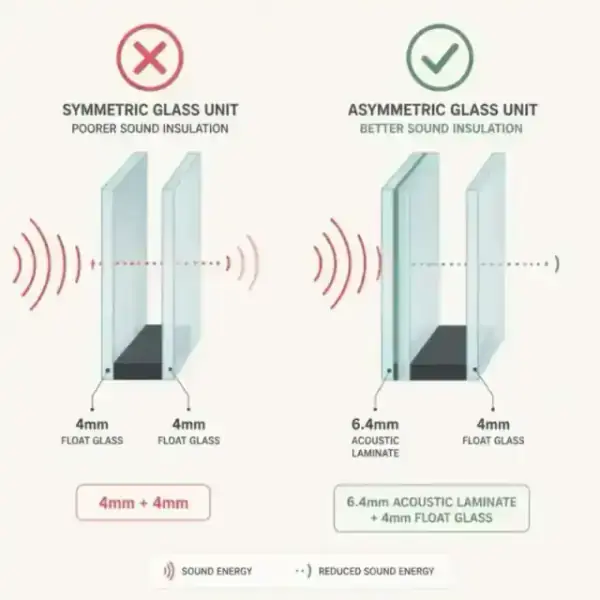
Symmetry is beautiful in architecture, but it’s a disaster for acoustics. If you have two panes of glass that are the same thickness (say, 4mm and 4mm), they will both vibrate at the same frequency. This is called the "coincidence frequency," and it allows sound to pass through as if the glass wasn't even there.
The Fix: You need "asymmetric glazing." By using different thicknesses: for example, your original 4mm sash window paired with a 6.4mm internal acoustic laminate: you ensure that each pane handles different frequencies. One pane stops the high-pitched sirens, while the other tackles the low-frequency rumble.
4. Underestimating the Power of Acoustic Laminate
Many people think "thicker is better" and try to install 10mm or 12mm float glass. While mass is good, standard glass is stiff and still vibrates. Acoustic glass is a different beast entirely. It’s a "sandwich" of two glass panes held together by a special acoustic PVB (Polyvinyl Butyral) interlayer.
This interlayer acts like a dampener: think of it as a shock absorber for sound waves. It absorbs the vibration rather than passing it through.
The Fix: Always specify acoustic laminate for your secondary units. It’s thinner and lighter than heavy float glass but performs significantly better across the entire decibel (dB) spectrum.
5. Leaving the "Leaks" Unplugged
You can buy the most expensive acoustic glass in the world, but if your window isn't airtight, you’ve wasted your money. Sound travels through air. If air can get in, noise can get in.
Common culprits include:
- Trickle Vents: These are essentially holes in your window. On a London Red Route, a trickle vent is a direct megaphone for traffic noise.
- Worn Seals: Old sash windows are notorious for gaps where the sashes meet.
- Frame Gaps: The space between the window frame and your wall.

The Fix: Ensure your installation is airtight. Secondary glazing frames should be sealed to the masonry with high-density acoustic sealant. If you have trickle vents in your primary windows, a secondary glazing unit fitted over them acts as a "buffer box," allowing for ventilation when you want it but blocking the direct line of sight for sound.
6. Ripping Out Period Windows
In London, we love our Victorian and Georgian sash windows. A common mistake is thinking you have to rip them out and replace them with "modern soundproof" plastic windows to get results.
Not only does this often require planning permission or listed building consent, but it also frequently performs worse than the original window plus secondary glazing. Most replacement windows can't provide the 100mm air gap necessary for serious noise reduction.
The Fix: Keep the heritage, fix the noise. Secondary glazing is installed internally, meaning you keep your beautiful original sashes, satisfy the conservation officers, and achieve a higher level of soundproofing than any single replacement unit could offer.
7. Chasing "Cheap" Instead of "Decibels"
Soundproofing is a science, not a DIY project. We often see homeowners try to fix noise with heavy curtains, "acoustic foam" from the internet, or cheap DIY secondary glazing kits that use thin acrylic and magnetic strips.
These might take the edge off a light breeze, but they won't touch the 70-80dB roar of a London A-road.
The Fix: Look at the numbers. Decibels are logarithmic. A 3dB reduction is technically a halving of sound energy, but a 10dB reduction is what the human ear perceives as a 50% drop in volume. Our professional secondary glazing systems can achieve up to a 54dB reduction. When you compare that to the 25-30dB of standard double glazing, the difference isn't just a number: it’s the difference between a stressful home and a sanctuary.
Ready to Silence the City?
If you're tired of being woken up by the 5 AM bin lorry or the constant hum of the A4, don't just guess at the solution. Every home in London is different, from the thickness of the brickwork to the height of the window reveals.
We provide a bespoke survey to measure your specific noise levels and recommend the exact glass and gap combination you need. It’s usually 40-60% cheaper than full window replacement, takes a day to install, and( most importantly( it actually works.))
WhatsApp us